




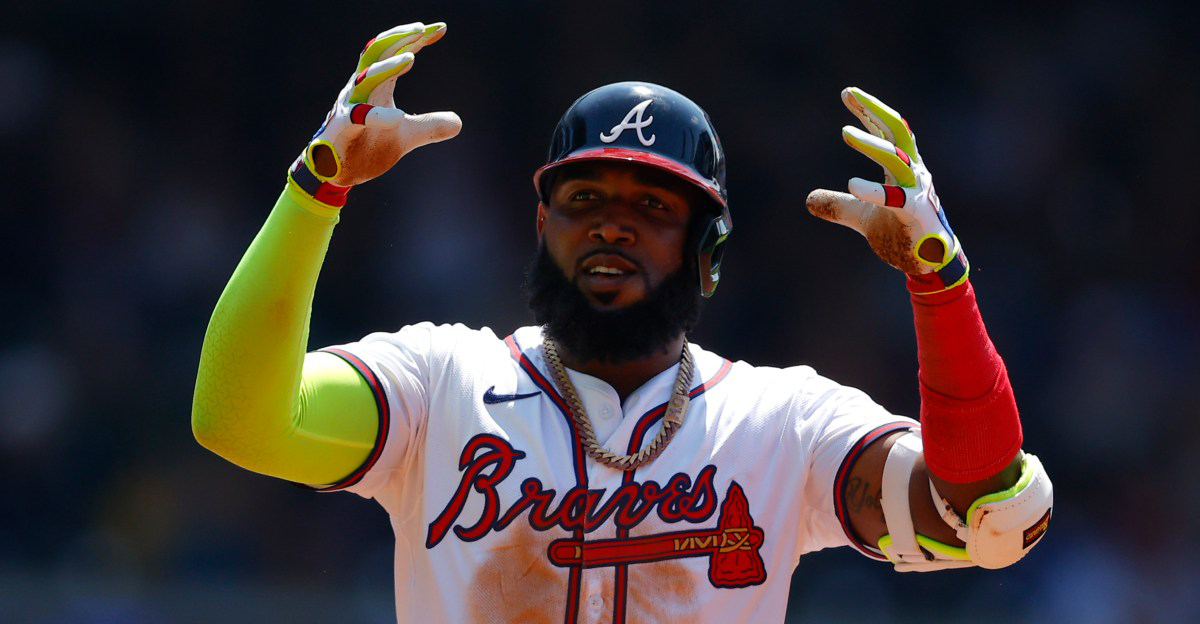
PITTSBURGH: The Pittsburgh Pirates have made a significant move to address their anemic offense, reaching agreement with veteran designated hitter Marcell Ozuna on a one-year, $12 million contract with a mutual option for 2027. The deal, pending a physical, will pay Ozuna $10.5 million for the 2026 season with a $16 million mutual option for 2027 that includes a $1.5 million buyout.
The signing represents a crucial investment for a Pirates franchise desperate to provide offensive support for what has been one of baseball's most dominant starting rotations—a rotation that suffered through historically poor run support during the 2025 campaign.
A Season Of Squandered Excellence
The Pirates' pursuit of Ozuna comes on the heels of one of the most frustrating seasons in recent franchise history, despite boasting two of the National League's premier starting pitchers. While Paul Skenes delivered a Cy Young-caliber performance with a microscopic 1.97 earned run average over 187.2 innings and Mitch Keller anchored the rotation, the Pirates offense repeatedly failed to capitalize on their brilliance.
The numbers tell a damning story. According to Baseball-Reference, Skenes received just 3.4 runs of support per game during the 2025 season—well below the major league average of 4.5 runs per game for starting pitchers. This anemic offensive output led to Skenes posting a 10-10 record despite his dominance, making him the only pitcher in Major League Baseball history since earned run average became an official statistic in 1913 to finish a season with at least 200 strikeouts and an ERA below 2.00 without recording a winning record.
Keller's situation was equally egregious. By mid-June 2025, Keller had suffered through a nine-decision losing streak despite consistently keeping his team in games, sporting a 1-9 record while maintaining respectable numbers. Out of 74 qualifying pitchers in MLB during the first half of the 2025 season, Keller ranked dead last in run support per nine innings at just 2.14 runs. Both Skenes and Andrew Heaney also ranked in the bottom six league-wide in run support.
The Pirates finished the 2025 season with a 71-91 record, placing fifth in the National League Central division. More alarmingly, the team produced a major league-worst 117 home runs—a staggering indictment of their power shortage. This offensive futility wasted exceptional starting pitching that deserved far better fate, prompting urgent action in the offseason to prevent another season of squandered excellence.
The Big Bear Comes To Pittsburgh
Enter Marcell Ozuna, a three-time All-Star and proven power threat who brings a distinguished 13-year major league pedigree to the Steel City. Nicknamed "the Big Bear," the 35-year-old Dominican Republic native represents exactly the type of middle-of-the-order presence the Pirates desperately lacked in 2025.
Ozuna's career trajectory has been marked by both tremendous highs and challenging periods, but his track record speaks to his ability to impact games with his bat. Over his major league career spanning parts of 13 seasons with the Miami Marlins, St. Louis Cardinals, and most recently the Atlanta Braves, Ozuna has compiled a .269 batting average with 296 home runs and 948 RBIs across 6,045 at-bats.
From Miami Prospect To All-Star
Signed by the then-Florida Marlins as an international free agent in February 2008 for a $49,000 bonus, Ozuna steadily climbed through the minor league ranks. He made his major league debut on April 30, 2013, replacing an injured Giancarlo Stanton in the Marlins outfield. After recording his first career hit off the Mets' Jeremy Hefner, Ozuna quickly established himself as a legitimate big-league talent.
His breakout season came in 2017, when Ozuna earned his first All-Star selection as a starter for the National League. That year, he slashed .312/.376/.548 with 37 home runs and 124 RBIs—finishing fourth in the NL in batting average and third in both home runs and runs batted in. His exceptional two-way play earned him both a Gold Glove Award and Silver Slugger Award, cementing his status as one of baseball's premier outfielders.
The St. Louis Chapter
Following his stellar 2017 campaign, the Marlins traded Ozuna to the St. Louis Cardinals in December 2017 in a deal that sent Sandy Alcántara, Magneuris Sierra, Zac Gallen, and Daniel Castano to Miami. The trade would prove costly for St. Louis in the long term, as Alcántara and Gallen developed into frontline starting pitchers.
Ozuna signed a one-year, $9 million contract with the Cardinals for the 2018 season. He delivered solid production in his first year in St. Louis, batting .280 with 23 home runs and 88 RBIs in 148 games while earning NL Player of the Week honors in mid-June. Highlights included his first career walk-off home run against the Colorado Rockies at Busch Stadium and a grand slam against the Pittsburgh Pirates.
His second season with the Cardinals in 2019 was interrupted by a finger fracture that placed him on the injured list from late June through early August. Despite the setback, Ozuna finished with 29 home runs and 89 RBIs over 130 games. He saved his best for the postseason, batting .429 with nine hits and five RBIs in the Cardinals' five-game National League Division Series loss to the Atlanta Braves.
Resurgence In Atlanta
Ozuna signed with the Atlanta Braves on a one-year, $18 million contract in January 2020, beginning what would become a six-year tenure in Georgia. The shortened 2020 season proved to be one of the finest of his career. In just 60 games, Ozuna batted .338/.431/.636—each ranking third in the National League—while leading the NL with 18 home runs, 56 RBIs, and 145 total bases.
His exceptional performance earned him his second Silver Slugger Award and made him the first National League player to win the honor at designated hitter following the implementation of the universal DH rule during the COVID-19 pandemic. On September 1, 2020, Ozuna became the first National League player to hit three home runs in a single game at Fenway Park. When teammate Adam Duvall matched the feat the following day, they became the first teammates in MLB history to hit three home runs each in consecutive games.
The Braves rewarded Ozuna's performance with a four-year, $64 million contract in February 2021. However, personal and legal issues derailed his 2021 season, and he missed the Braves' World Series championship run.
Recent Performance And The Road To Pittsburgh
Ozuna rebounded with a solid 2022 campaign, hitting 23 home runs over 124 games. In 2023, he reached a career-high 40 home runs, hitting two in the regular-season finale to help the Braves tie the 2019 Minnesota Twins' single-season home run record.
The 2024 season represented a renaissance for Ozuna at age 33. He posted arguably his best offensive campaign in a full season, batting .302 with 39 home runs, 104 RBIs, and a .925 OPS. His performance earned him his third All-Star selection and a fourth-place finish in National League MVP voting. In 2023 and 2024 combined, Ozuna slashed .289/.364/.552 with 79 home runs and 204 RBIs, leading the Braves with a 148 OPS+.
However, the 2025 season proved more challenging. Over 145 games, Ozuna's production declined to .232/.283/.473 with 21 home runs and 68 RBIs. The Braves experienced a disappointing season overall, finishing below .500 for the first time since 2017 and missing the playoffs. With Atlanta facing roster decisions and salary considerations, both sides agreed to part ways, making Ozuna a free agent.
What Ozuna Brings To The Pirates
Despite his age and the statistical drop-off in 2025, Ozuna represents a significant upgrade for a Pirates lineup that ranked among the worst in baseball in power production. His 21 home runs in 2025 alone would have ranked second on the Pirates' roster behind only Matt Goretzka, highlighting the franchise's power void.
As a designated hitter, Ozuna fills a critical need without blocking the development of younger position players in the field. His right-handed bat provides balance to the Pirates' lineup, and his veteran presence offers leadership for a young core that includes Skenes and emerging position players.
Ozuna's postseason experience—including his exceptional 2019 NLDS performance—brings playoff knowledge to a franchise that hasn't reached the postseason since 2015. If the Pirates can leverage improved offense to support their elite pitching, Ozuna could play a pivotal role in ending that drought.
The Broader Context
The Ozuna signing represents more than just adding a bat; it signals organizational urgency to capitalize on the Paul Skenes era before it's too late. As detailed in recent analysis, there's genuine concern among Pirates fans that Skenes could follow the path of Gerrit Cole, who was also the first overall draft pick by Pittsburgh before being traded to Houston after five seasons due to the franchise's inability to build a competitive roster around him.
Cole, selected first overall in the 2011 draft, made 127 starts for the Pirates before being traded in January 2018. In his final Pittsburgh season (2017), Cole's actual value based on his 3.4 WAR was approximately $27.1 million according to FanGraphs, yet he earned just $3.75 million. He subsequently signed a nine-year, $324 million contract with the New York Yankees after two successful seasons with the Astros.
Skenes, who received a $9.2 million signing bonus as the first overall pick in the 2023 draft, is earning just $875,000 for the 2025 season despite FanGraphs calculating his true market value at $51.8 million based on his 6.5 WAR. He won't be eligible for arbitration until after the 2026 season, with free agency not arriving until after 2029.
The urgency is palpable: the Pirates cannot afford to waste Skenes' prime years with inadequate offensive support. His 216 strikeouts in 2025 made him the single-season strikeout leader among right-handed pitchers in franchise history, surpassing legendary names. To see such brilliance rewarded with a .500 record due to offensive futility represents both a tragedy and a call to action.
Financial Implications And Future Outlook
The one-year structure with a mutual option provides flexibility for both parties. If Ozuna rebounds to his 2023-2024 form, the Pirates can exercise the $16 million option for 2027, or Ozuna can explore free agency if the fit isn't ideal. If performance declines, Pittsburgh can pay the $1.5 million buyout and pursue other options.
The deal also leaves the Pirates room to make additional moves. While signing Ozuna addresses power production, the team still needs to add depth across multiple positions to truly compete in the competitive NL Central division.
Questions remain about how Ozuna's addition affects beloved franchise icon Andrew McCutchen, whose future with the Pirates has become murky following the signing. The 39-year-old former NL MVP has signed one-year deals with Pittsburgh for each of the past three offseasons, serving as both a designated hitter and mentor to younger players.
A Calculated Risk With High Upside
For the Pittsburgh Pirates, signing Marcell Ozuna represents a calculated risk with potentially significant rewards. While his 2025 numbers showed decline, his recent track record includes two exceptional seasons that demonstrated he can still be an impact middle-of-the-order bat. At age 35, Ozuna may not be the .300 hitter with 40-home run potential he was two years ago, but even a return to 30-home run production would transform the Pirates' offensive outlook.
More importantly, this signing sends a message—to Paul Skenes, to Mitch Keller, to the fanbase, and to the broader baseball world—that the Pirates organization recognizes the urgency of the moment. With one of baseball's most exciting young pitchers entering his prime and another talented starter in Keller providing a formidable one-two punch, the time for action is now.
The 2025 season proved that excellent pitching alone cannot overcome historically poor offensive production. With Ozuna now in the fold, the Pirates have taken a meaningful step toward ensuring their starting rotation receives the run support it deserves. Whether this move represents the beginning of a genuine competitive resurgence or merely a temporary stopgap remains to be seen, but for a franchise starved for playoff baseball since 2015, any step forward is progress worth celebrating.
As spring training approaches, all eyes will be on PNC Park to see if the Big Bear can help the Pirates finally provide the offensive firepower needed to complement their pitching excellence—and perhaps, finally, to keep history from repeating itself with another generational pitching talent leaving Pittsburgh in search of championship contention elsewhere.