




DUBOIS: DuBois City Council voted Wednesday night to authorize city administration to begin preliminary regulatory steps toward potentially removing fluoride from the city’s public water supply, a move officials repeatedly stressed is not a final decision and will involve additional public notice, review, and public hearings.
The discussion comes amid renewed national and local debate over water fluoridation — a public health practice that has been in place for decades and is still supported by major medical and dental organizations, but which continues to raise questions about individual choice, operational risk, and cumulative exposure.
What Council Actually Approved — And What It Didn’t
Interim Co-City Manager Ben Kafferlin said the issue was raised at a prior meeting when a council member questioned whether the city should continue fluoridating its water. Initial discussion suggested a public referendum might be required, but further research determined that removal would instead involve a permitting process through the Pennsylvania Department of Environmental Protection.
“This is still a process, but a less involved process than originally thought,” Kafferlin said.
Under DEP rules, discontinuing fluoridation would require a major permit amendment, advance public notice to water customers and medical professionals, and updates to the city’s annual Consumer Confidence Report. No change to the water supply occurs as a result of Wednesday night’s vote.
City Solicitor Jason Sabol emphasized that point.
“This is council authorizing administration to take further steps toward removal of fluoridation,” Sabol said. “It’s not a final vote to remove fluoride from the water.”
History Of Flouride Use In DuBois
Fluoride has been part of the City of DuBois public water supply for more than six decades, following a community-wide debate and voter decision in the mid-20th century. In 1964, fluoridation emerged as a significant local issue as national public-health efforts promoted fluoride as a tool to reduce tooth decay. That year, DuBois residents voted in a municipal referendum on whether fluoride should be added to the city’s drinking water. The measure passed by an overwhelming margin, formally authorizing the city to move forward with fluoridation of the water system.
Local civic groups played a visible role during that period, particularly the DuBois Area Jaycees, who were widely credited with leading an educational campaign ahead of the 1964 vote. Contemporary accounts describe the Jaycees organizing informational outreach to residents about dental health and fluoridation, helping frame the issue for voters at the time. While historical records clearly document their involvement in public education, available sources do not definitively establish whether the organization directly funded fluoridation equipment or materials. Since the referendum’s passage, fluoridation has remained part of DuBois’s water treatment process, periodically resurfacing in public discussion as residents revisit the policy decades after its adoption.
Current Fluoride Levels In DuBois Water
According to the city’s most recent Consumer Confidence Report, DuBois’ water contains fluoride at 0.417 parts per million, added intentionally to promote dental health.
For comparison:
- Federal regulations allow fluoride levels up to 4.0 mg/L
- Pennsylvania’s maximum is 2.0 mg/L
- The U.S. Public Health Service recommends an “optimal” level of 0.7 mg/L
City staff and consultants compiled a detailed memo outlining the advantages, disadvantages, and regulatory steps involved in discontinuing fluoridation, drawing on both public health research and operational considerations.
Why Fluoride Is Added To Public Water: Evidence And Context
Fluoride is not added arbitrarily. Its use in public water supplies is based on decades of public health research showing that, at controlled levels, fluoride significantly reduces dental decay — particularly among children — and helps reduce oral health disparities across income and access levels.
Origins Of Fluoridation
In the early 20th century, researchers observed that communities with naturally occurring fluoride in groundwater had lower rates of cavities. Those observations led to formal studies, culminating in 1945, when Grand Rapids, Michigan became the first U.S. city to intentionally fluoridate its water supply. Long-term follow-up showed substantial reductions in tooth decay, helping establish fluoridation as a national public health strategy.
What Science Says About Fluoride’s Benefits
1. Prevents Dental Cavities
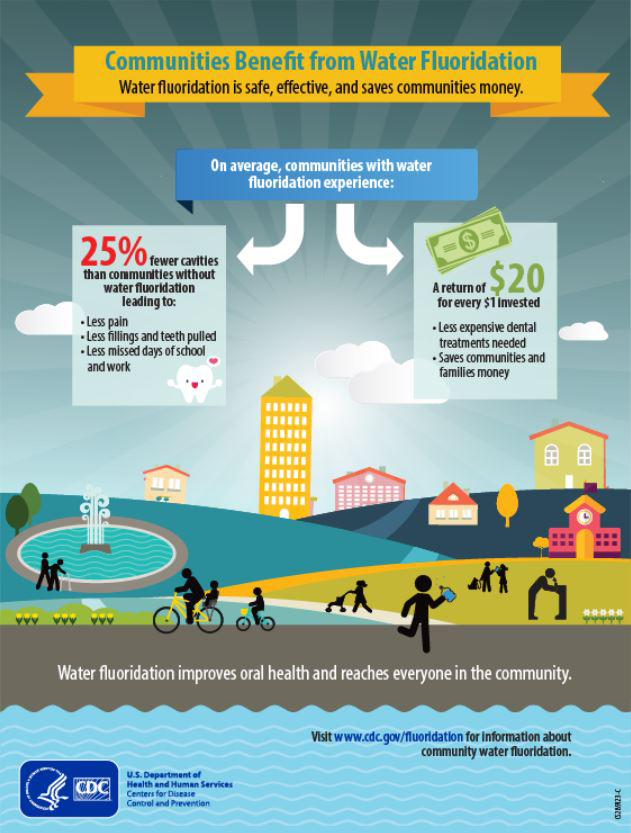
Extensive research shows community water fluoridation reduces tooth decay. Systematic reviews estimate reductions of approximately 25–44% in both children and adults.
2. Works Across Socioeconomic Groups
Fluoridated water benefits residents regardless of access to regular dental care, helping narrow oral health disparities.
3. Cost-Effective Public Health Strategy
Because water fluoridation provides continuous low-level exposure, it is considered one of the most cost-efficient ways to prevent tooth decay — one of the most common chronic diseases.
4. Reinforced by Major Health Organizations
National and international health bodies, including the Centers for Disease Control and Prevention and the American Dental Association, continue to endorse community water fluoridation as safe and effective.
How Fluoride Works
Fluoride strengthens tooth enamel, making it more resistant to acids produced by decay-causing bacteria. Regular exposure through drinking water provides continuous protection, rather than relying solely on brushing or dental treatments.
Potential Risks And Ongoing Concerns
The council memo also reflects commonly raised concerns by opponents of fluoridation.
Dental fluorosis, a typically mild cosmetic discoloration of teeth, can occur when young children are exposed to excess fluoride from multiple sources during tooth development.
Some studies have examined associations between very high fluoride exposure and outcomes such as reduced IQ or impacts on nutrient absorption. These studies generally involve fluoride levels far above those used in community water fluoridation and remain controversial and scientifically contested.
Authoritative scientific bodies conducting systematic reviews — including those informing CDC guidance — have not found convincing evidence that fluoride at recommended public-health levels causes major systemic health harms.
Operational Considerations For The City
Kafferlin told council that discontinuing fluoridation could reduce chemical-handling risks and save approximately $5,000 per year.
“It does cost us something to have those chemicals — not just literal dollars, but also the risk and added permitting,” he said. “It is a toxic chemical that adds a level of risk for us handling it.”
Public Works Director Scott Farrell said the water department supports removal due to the hazardous nature of the chemical, noting he was not aware of any naturally occurring fluoride in the city’s water supply.
Councilman Sam Mollica raised questions about natural fluoride levels during discussion.
What Happens Next
Kafferlin emphasized that even if council ultimately decides to discontinue fluoridation, the process would take months.
“This is probably a two- or three-month process before, at six months, we would stop doing it,” he said. “This is not the last chance for public comment.”
Sabol recommended holding a public hearing before any final decision, citing the level of public interest typically associated with fluoride policy.
Council unanimously approved the motion authorizing administration to proceed with drafting permit modifications and conducting any necessary studies.
Key Studies And Reports (With Links)
CDC Scientific Statement on Fluoridation – Comprehensive review of safety and effectiveness
https://www.cdc.gov/fluoridation/about/statement-on-the-evidence-supporting-the-safety-and-effectiveness-of-community-water-fluoridation.html
Systematic Reviews Showing 26–44% Reduction in Caries
https://www.sciencedirect.com/science/article/pii/S2161831325001851
Historical Fluoridation Evidence – Dental decay decline after fluoridation
https://mequonsmiledesign.com/alternatives-to-removal-of-fluoride-from-municipal-water/
High-Exposure Risk Debate – Dental fluorosis correlations at elevated levels
https://www.mdpi.com/2071-1050/15/16/12227
Neurological Outcomes Research (Controversial) – Meta-analysis on fluoride and IQ
https://pubmed.ncbi.nlm.nih.gov/39761023/