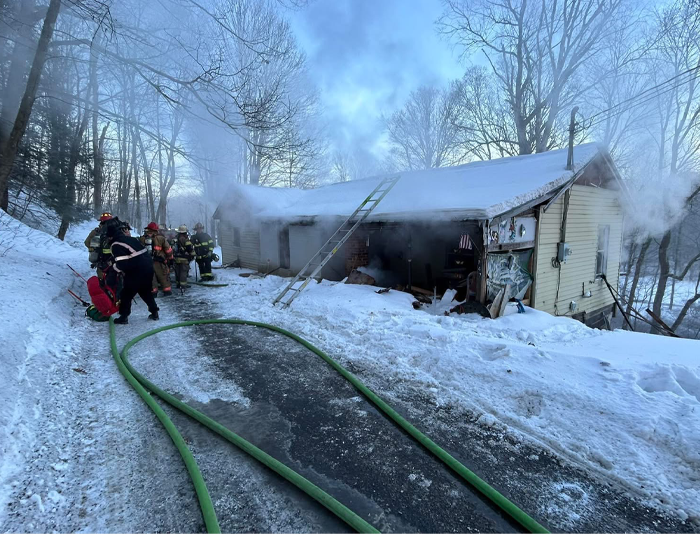






Few words carry more goodwill in a community than "volunteer". It implies sacrifice, service, and people giving their time without expecting anything in return. That’s why the word matters. And that’s why it deserves protection from quiet erosion. Hundreds in the DuBois Volunteer Fire Department live up to the role and the meaning of the word. But there are those that may well find themselves on the far side of the invisible ethical line.
This week, DuBois City Council approved a request from the DuBois Volunteer Fire Department to sell aging fire apparatus and use the proceeds to help purchase vehicles for department leadership. The decision passed, but it should not have passed without any scrutiny. I haven't showered Dick Whitaker with many compliments, but, credit where due, I'm glad he at least asked a question.
Once volunteers begin compensating themselves through perks rather than paychecks, the public has every right—arguably an obligation—to ask uncomfortable questions. So today I come to you void of any shyness I might have otherwise let get in my way with some food for thought for you to digest. . . even if you live elsewhere in the region but also depend on a volunteer department to service your locale.
Let’s start with the simplest question:
If this is a volunteer organization, why are leadership vehicles necessary at all?
Volunteers, by definition, donate their labor. They may be reimbursed for expenses directly tied to service—fuel to respond to a call, equipment needed to do the job—but they do not typically acquire personal-use assets through their role. When they do, the line between volunteer service and compensated position begins to blur.
Another question follows quickly, and it may sting:
Can’t leadership afford their own darn vehicles? This shouldn't be a creative way for the brass to combat inflation.
That is not meant solely as an insult. It is a governance question. Most volunteers in this community—firefighters included—drive to calls in their own cars, on their own insurance, using their own fuel. If rank-and-file members manage this, why does leadership require vehicles funded by the sale of public safety equipment?
And if leadership vehicles are truly essential, why must they be funded by liquidating fire apparatus rather than through transparent budgeting, city-owned fleet policies, or reimbursement models with clear limits and reporting?
Selling emergency equipment is not a trivial matter. Even “aging” apparatus has value—not just financially, but operationally. Once sold, it is gone. The public is entitled to ask whether every alternative was explored before converting emergency assets into leadership convenience.
There is also a fairness question that cannot be avoided:
Do all volunteers receive equivalent benefits?
If the answer is no—and it appears to be no—then the department must explain why leadership roles entitle some volunteers to benefits unavailable to others. Otherwise, the term “volunteer” becomes selective, applied proudly when asking for public support, but flexibly when distributing perks.
Supporters will argue that leadership needs tools to do their jobs efficiently. That may be true. But tools owned by whom? Governed how? Used under what policy? And valued at what cost?
Perks are not free simply because they are not wages. Vehicles carry purchase costs, insurance, maintenance, fuel, depreciation, and potential tax implications. When perks replace pay, compensation becomes harder to see—and easier to defend without oversight.
None of this is an attack on firefighters or their service. Quite the opposite in fact. Volunteer fire departments depend on public trust, donor confidence, and community goodwill. That trust is weakened when decisions appear to benefit insiders without clear justification.
This isn’t about dedication. It’s about accountability.
If leadership vehicles are necessary, then let the case be made openly. Put policies in writing. Define ownership. Restrict use. Publish costs. Ensure that benefits align with mission—not status.
Because once the word “volunteer” starts coming with perks, the public is justified in asking whether it still means what it used to.
And if those questions feel uncomfortable, that may be the clearest sign they are the right ones to ask.
I do not have a booth at the fair or a crystal ball, but in the weeks and months to come, I suspect an initiative to be led by Mayor Gargamel that directs millions at the Oklahoma Fire Hall, fullfilling one of the quieter (and really expensive) campaign promises that he made on the trail where he offered little to the voting public besides his government name (J. Barry Abbott) on yard signs. In the grand scheme of things, that project may cost 50 to 70 times what this equipment might sell for, but a head start would seem like a better, more fiscally prudent, approach. When I see the ease by which folks in leadership roles spend other people's money, I can't help but wonder how long it will be before the new city borrows a page from its dad (the old city of DuBois) and starts shelling out for weddings, shopping sprees, gambling excursions, and private celebrations. If they have to pick one to start with, I suggest some partying while one of the key, honored guests is still a free man.